Agentic AI on Mobile Phones: Google & Samsung’s Big Bet

Agentic AI on mobile phones is the biggest change to smartphone technology since the touchscreen. For the last several years, smartphone AI has been ask a question, get an answer. You opened the assistant, typed or spoke a request, and it responded, sometimes helpfully, often not. That time is about to end.
But now Google and Samsung are betting on something much more basic. Agentic AI on mobile phones means your device doesn’t just answer questions, it does things for you.
Past the Chatbot: AI That Acts
The key shift is from reactive to proactive intelligence. Old school assistants wait for orders. Mobile phones have agentic AI that understands context and acts autonomously.
Samsung has released the Galaxy S26 series in February 2026, which it is calling “the beginning of truly agentic AI”. Now the phone knows what you’re doing, and can suggest actions before you ask.
Take Samsung’s new feature, “Now Nudge.” It reads the conversational context and brings up relevant suggestions, without you having to switch between apps. If someone messages about a meeting, your phone might suggest adding it to your calendar. This isn’t a chatbot waiting for a prompt — this is an agent embedded in the fabric of your device.
The real breakthrough: cross app task automation
Screen automation is the most concrete agentic feature coming soon. Google’s Gemini can now control supported apps and perform multi-step tasks on Galaxy S26 series and Pixel devices.
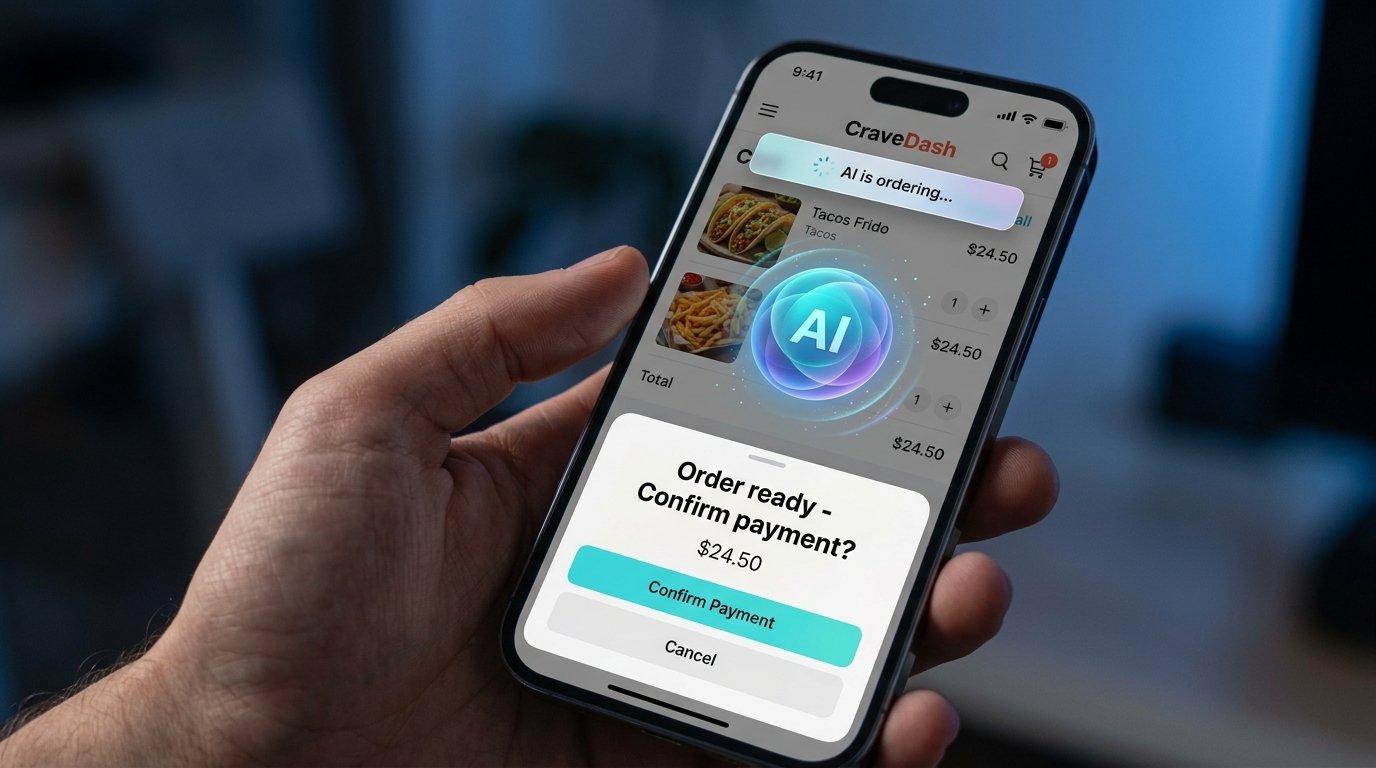
This is what it looks like in practice. You ask Gemini to “order a spicy chicken sandwich from Popeyes on Uber Eats.” Gemini opens Uber Eats, locates the item, adds it to your cart and guides you through the ordering flow – all in a background virtual window while you continue to use your phone. It will stop at the final payment screen and send you a notification. You check the order, hit confirm. AI does the heavy lifting, you make the final call.
Same goes for rideshare bookings. Tell Gemini to get you an Uber home, and it opens the app, chooses your destination and selects a ride type. You simply confirm and pay. We currently support Uber, Lyft, DoorDash, Grubhub, Uber Eats and Starbucks, with Instacart coming soon.
What’s New Here Compared to Old Voice Assistants
Three technical changes make this leap possible.
On-device computation. The Pixel 11 uses the Tensor G6 chip to run Gemini Nano locally, meaning it can do more AI processing without sending everything to the cloud. Samsung’s Personal Data Engine learns user preferences on-device, and Knox Enhanced Encrypted Protection isolates data within individual apps.
Multimodal comprehension. The phone isn’t merely parsing text commands. It can also see what’s on your screen. Google demonstrated a scenario in which you take a picture of a travel brochure in a hotel lobby and ask Gemini to “find a similar tour on Expedia for six people.” The AI knows what the picture is, looks it up on the internet, and books it.
Limits for safe operation. Gemini Intelligence is built for explicit user control, Google says. It only has access to the apps you give it permission to use, it needs confirmation before it makes any purchases and it shows you real-time indicators when it’s acting on your behalf. You can watch the progress in a ‘live view’, and jump in to take manual control at any time.
The Privacy Paradox
This ability comes with an inherent tension. For an agent to be useful, it needs wide access to your screen, notifications, and app data. The more it sees, the more it can help – and the more information it touches.
Google’s answer is architectural. It stresses that automation only occurs when you request it, operates in a separate virtual window, and cannot access the remainder of your device. Sensitive data remains local for on-device models. When cloud processing is required, Google says it secures ambient data with technologies like Private Compute Core.
But security researchers caution agentic AI introduces new classes of risk. The challenge is called “prompt injection,” according to a framework called PrivAuto, introduced at an academic conference in 2026, and involves hidden instructions in content that could trick an agent into leaking data. An agent acting under the proper permissions can still be fooled into committing harmful acts. Google says it is working to build safeguards against this, including protections similar to those in Chrome’s auto-browse feature.
What it means for you
The practical upshot is simple: your phone is becoming less a tool you operate and more an assistant that operates on your behalf. It can only do limited tasks today – food delivery, rideshare, some calendar and photo management – but the groundwork is being laid for more autonomy.
The question is not if agentic AI will be the norm. Both Google and Samsung have vowed to bring these capabilities further down their ecosystems, including wearables, cars and laptops. The question is how comfortable are you with delegating more of your digital life to a system that doesn’t just answer but acts.