AI Agent: What It Is, How It Works and Why It Matters


An AI agent is a software system that comprehends a goal, develops a plan, utilizes external tools, and carries out multiple steps to achieve the goal, with minimal human guidance. An agent acts. Not just answer one question at a time like a chatbot. Its value is entirely dependent on how well designed it is, what permissions it has, and whether a human is kept in the loop for high stakes decisions.
Artificial intelligence is capable of more than just question-and-answer exchanges. The AI agent can understand a goal, plan a sequence of actions, use external tools, and execute tasks in multiple steps, all without waiting for instructions at every turn.
That transition — from asking questions of A.I. to assigning it tasks — is what has made agents one of the tech industry’s most-discussed developments.
What Is an AI Agent?
An AI agent is a computer program that applies artificial intelligence to understand a task and figure out what needs to be done and then takes a series of actions to achieve a specified goal.
The difference is illustrated by a simple example. Rather than asking an AI to “write a marketing plan,” you could ask an agent to research your target market, pull data on competing products, organize its findings—and then write the plan—all from a single instruction.
Systems’ capabilities vary widely. Modern agents, however, typically combine five things: reasoning, planning, memory, access to tools, and action. Google Cloud defines AI agents as systems that utilize these capabilities for complex tasks.
How Does an AI Agent Function?
The loop that most agents follow is familiar:
1. Grasps the objective. The agent figures out what the user needs and breaks down a hard job into smaller parts.
2. Develops a plan. It tells what needs doing and in what order.
3. Collects data. It may access documents, databases, web sites or other sources depending on the task.
4. Tool use. That’s what sets it apart from a simple chatbot. Agents can invoke APIs, query databases, search, and run software applications.
5. The agent does what it should do . Often it does multiple things , rather than outputting a single answer .
6. Verifies the result. Some agents read their own output and modify the next action if something goes wrong.

That loop — reason, act, observe, adjust — is what makes an agent different from a script. A script is a series of fixed steps; an agent chooses which steps to take.
Where AI Agents Are Employed
Agent applications are growing fast in industries:
- Customer service – answering questions, pulling account information, and walking users through service processes.
- Business Automation – Automating repetitive workflows like gathering information, writing reports and routine scheduling
- Research – gathering information from different sources and compiling or summarizing the findings
- Software development – programming, debugging, testing and documentation help
- Content Creation – research, outline, write, organize information
- Data analysis — manipulating datasets to find useful patterns and insights
Why Agents Matter: Tasks Vs. Questions
The change agents introduce are economic, not technical and the most important. The conventional AI prompt produces one output. A completed workflow is generated from an agent-based request.
Observe the difference:
Traditional prompt: “Write a product description for this phone.”
Agent-based request: “Investigate this smartphone, compare its key features, determine its intended users, and draft a product description.”
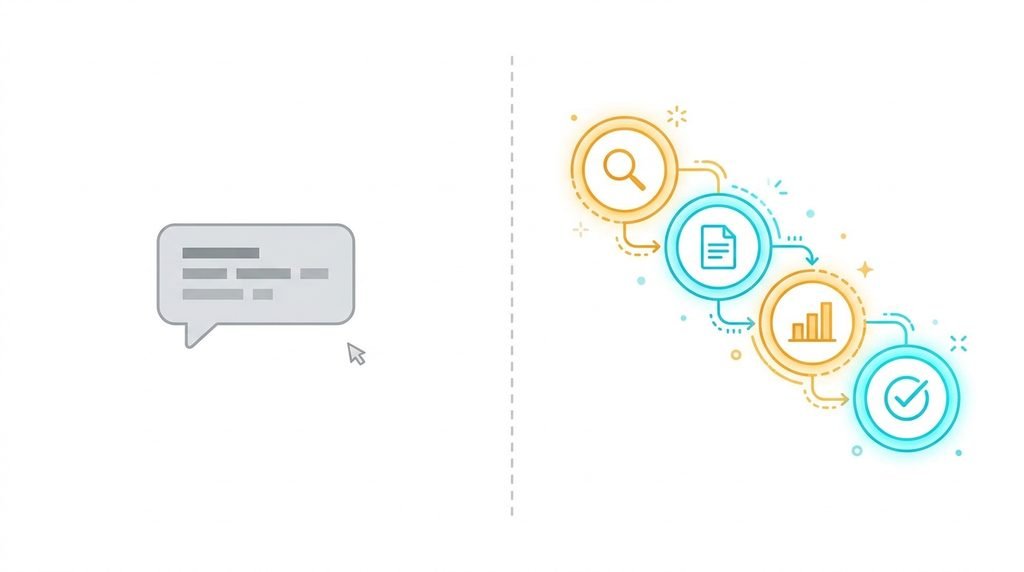
The first one produces text. The second one yields a result. It is in that gap – between creating content and finishing work – that agents create value.
Benefits of AI Agents
- Saves time through automation of repetitive tasks and workflows
- Managing complexity by dividing large goals into smaller, manageable parts
- Tool connectivity for software, APIs and databases
- Efficiency improvements with less manual work
- Contextual and memory-based personalization
- Scalability of structured, repeatable processes
These benefits are real, but they are contingent. Their effectiveness is largely a function of the quality of the agent’s design, the reliability of the tools it is connected to, and the clarity of the instructions it receives. A badly designed agent will automate errors faster than a human can.
Risks and Limitations
AI agents aren’t perfect, and it’s dangerous to act like they are.
Agents can misinterpret instructions, act on bad data, or make bad decisions. The stakes are much higher when an agent has access to sensitive information or the ability to act on behalf of a user—like financial transactions, confidential business information, important emails, and other high-impact activities that should require human approval.
Cost is another drawback. Sophisticated agents might require advanced AI models, databases, memory systems, and external tools. Simple problems don’t need an agent, and older, simpler models often are the smarter choice.
If you’re an organization selecting an agent architecture, Google Cloud’s AI agent architecture guide is a good place to start.
Bottom Line
The AI agent is a real leap forward for artificial intelligence. It can answer a prompt, but it can also understand a goal, make a plan, use tools, and take multiple steps to reach it.
Adoption is growing in customer service , research , coding and business automation . But agents should not only be judged by what they can do. Security, privacy, human control and reliability are just as important – if not more so.
New to agents and want to set one up on your device? Read our practical guide to AI agents on phones for step-by-step setup, permission checks, and security tips.








1 Comment
[…] Gmail Account from Being Hacked by implement a robust password, 2-Step Verification, passkeys, and other […]
Comments are closed.